In recent years I have noticed an increase in Germans using apostrophes in advertisement. I had always assumed this anglicized version of indicating the genitive case to be wrong. For example: Maria’s Buch instead of the proper form of Marias Buch.
This advertisement below, seen in the Oberurseler Woche from 10 Dec 09, prompted me to do more research.
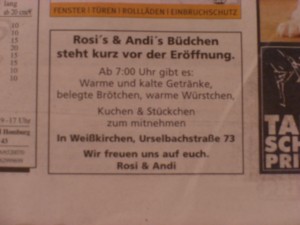
The apostrophe -to be or not to be
Generally, an apostrophe marks the omission of a letter.
In the case of Rosis and Andis Büdchen, it should be a simple genitive case written without apostrophe. Only for names ending in s, such as in Lukas, the apostrophe finds a usage -> Lukas’ Kneipe.
But in the meantime, the German Duden also has accepted this anglicized genitive. Quote: To mark the genitive before a name, an apostrophe may be placed to indicate the plain form of the name. (Zur Kennzeichnung des Genitivs von Namen wird gelegentlich ein Apostroph gesetzt, um die Grundform eines Personennamens zu verdeutlichen), listed example: “Andrea’s Blumenecke”. There we have it. Rosi and Andi either knew about this linguistic challenge before or they just got lucky with their spelling. In case you are wondering what a Büdchen is: it is the diminutive form of Bude (booth, joint, hangout).
It is worse to see the incorrect usage of the regular plural form. When weekends become weekend’s, my toes curl up. More about this language blunder in this post.
But zum mitnehmen is definitely wrong. Anytime a verb becomes a noun such as in: mitnehmen -> das Mitnehmen -> zum Mitnehmen, the verbal noun is capitalized.
Enough said about these lin’guistic’ hicc’ups for today.



So Duden have accepted the wrong usage and made it acceptable? I guess it’s one way of keeping the genetive alive…
When I was learning German at school, I definitely learnt not to set possive apostrophes after names.